
Guide
Ovulation tests and your fertile window
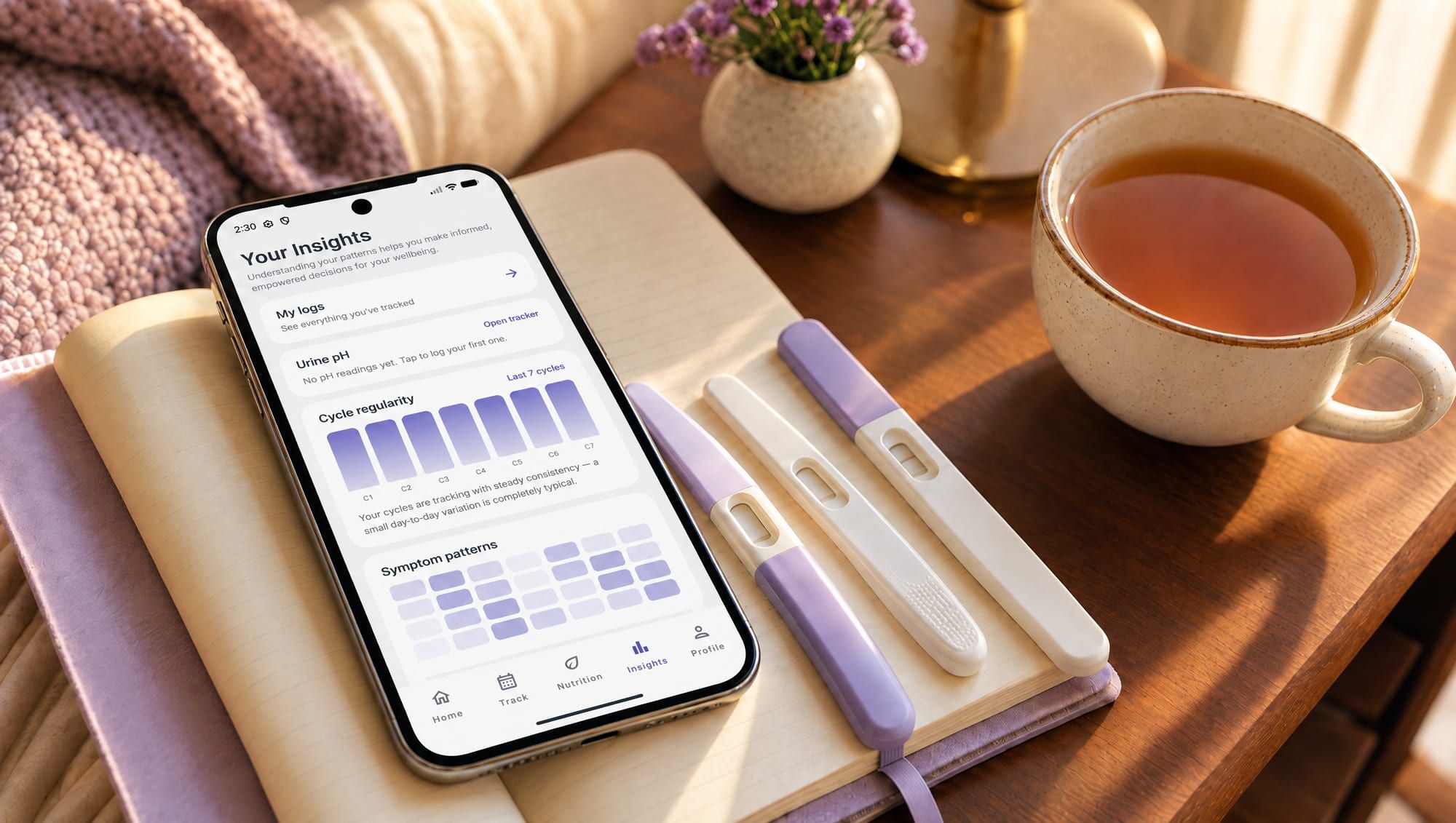
Your fertile window is about six days: the five days before ovulation and the day of ovulation itself. Ovulation tests detect the surge in luteinising hormone (LH) that comes one to two days before you ovulate, which helps you plan timing. If you simply want to get pregnant, the NHS advises sex every two to three days throughout your cycle. Genesyx includes ovulation tests and logs your results in its companion app.
What is the fertile window?
An egg lives for about 12 to 24 hours after it is released. Sperm can survive inside the body for several days (the NHS says up to seven). That combination creates a short fertile window each cycle.
A landmark 1995 study that tracked ovulation with daily hormone tests found that pregnancies came only from sex during a six-day window ending on the day of ovulation. The chance of conceiving rose from about 10% when sex was five days before ovulation to about 33% on the day of ovulation itself.
How ovulation tests work
Ovulation tests measure luteinising hormone (LH) in your urine. LH rises sharply shortly before an egg is released; this is the LH surge. Ovulation usually follows within about one to two days of the surge starting, so a positive test means your most fertile days are now.
A few tips for clearer results:
- Test at the same time each day, usually late morning or early afternoon
- Avoid drinking a lot in the two hours before testing, as it dilutes your urine
- Follow the timing on your test’s instructions exactly
- Keep testing until you get a positive, then stop for that cycle
When to start testing
Ovulation usually happens about 10 to 16 days before your next period, not a set number of days after your last one. Around 14 days before is typical, so the longer your cycle, the later you ovulate. Start testing a few days before you expect to ovulate.
| Cycle length | Likely ovulation day | Start testing around |
|---|---|---|
| 24 days | Day 10 | Day 7 |
| 26 days | Day 12 | Day 9 |
| 28 days | Day 14 | Day 11 |
| 30 days | Day 16 | Day 13 |
| 32 days | Day 18 | Day 15 |
| 35 days | Day 21 | Day 18 |
These are estimates. If your cycles vary, base your start day on your shortest recent cycle.
Other signs of ovulation
- Cervical mucus becomes clearer, wetter and stretchier, like raw egg white, around ovulation.
- Basal body temperature rises slightly after ovulation, so it confirms ovulation has happened rather than predicting it.
Timing and the Shettles routes
The Shettles method uses ovulation timing in opposite ways for its two routes: sex two to four days before ovulation when hoping for a girl, and as close to ovulation as possible when hoping for a boy. Research has not found that either route changes the baby’s sex. See how the routes compare in our guide to conceiving a girl or boy.
One practical point: the girl route asks you to stop before your most fertile days, so conception may take longer. If getting pregnant matters more to you than the route, the NHS advice is regular sex every two to three days throughout your cycle, which means you do not need to pinpoint ovulation at all.
How Genesyx uses your results
Log each test in the Genesyx companion app and it shows your estimated timing window for your chosen route, alongside your cycle and vaginal pH readings. Ovulation predictions are always estimates.
When to get advice
Speak to your GP if:
- your cycles are very irregular, or your tests never show a surge
- you have been trying to conceive for a year without success
- you are 36 or over, in which case the NHS suggests seeing your GP sooner
References
- Wilcox AJ, Weinberg CR, Baird DD. Timing of sexual intercourse in relation to ovulation. N Engl J Med. 1995;333(23):1517–1521. doi:10.1056/NEJM199512073332301
- NHS. Periods and fertility in the menstrual cycle.
- NHS. Trying to get pregnant.
- NHS. Infertility.
- Tommy’s. Timing of sex for pregnancy.
- StatPearls. Physiology, menstrual cycle. NCBI Bookshelf.
Evidence for the Shettles theory is mixed. Genesyx helps you follow the theory consistently; no outcome is guaranteed. This page is general information, not medical advice.